


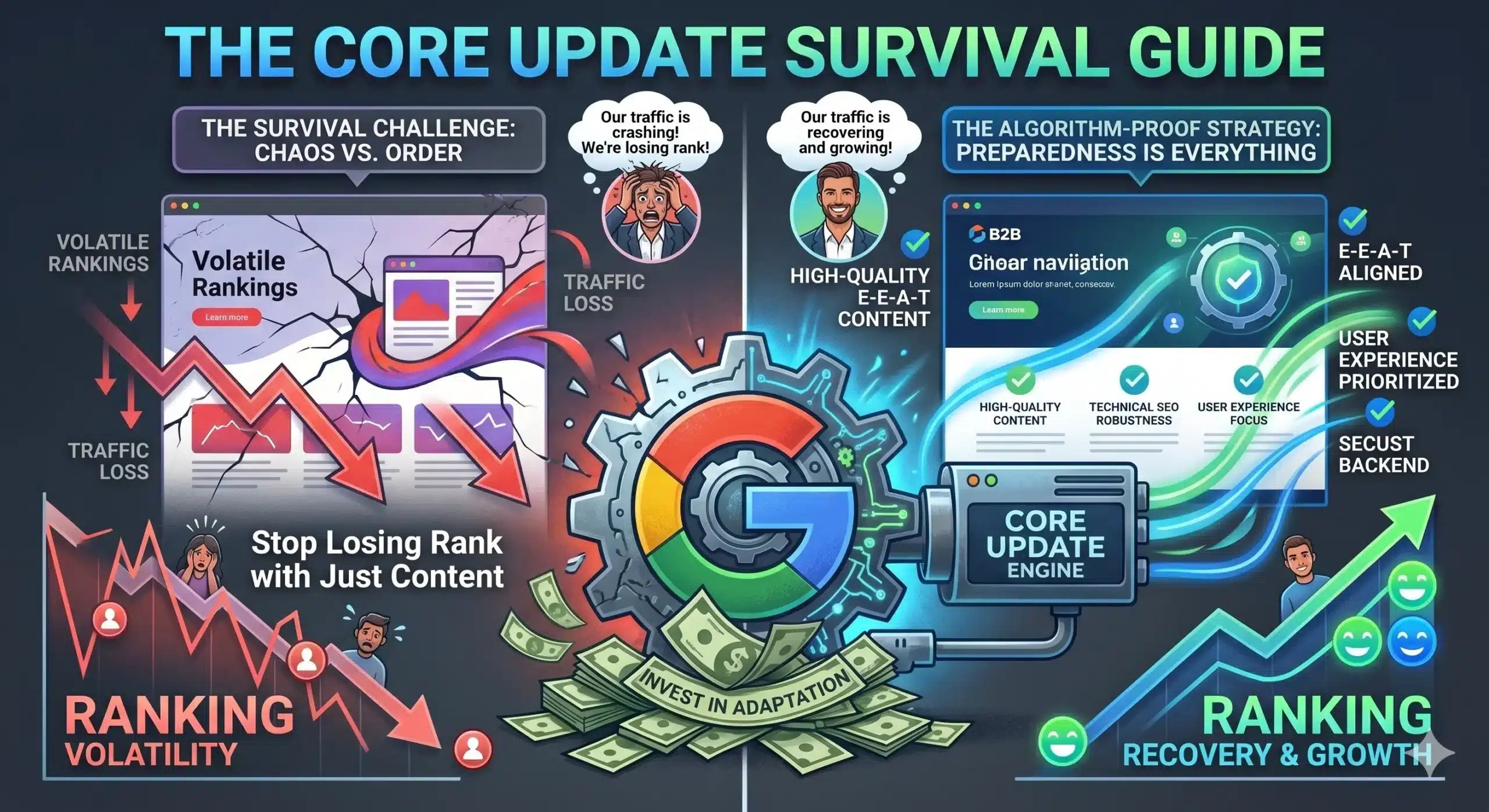
Something broke in early 2026 — and if your business relies on organic search, you already felt it. Across industries, website owners woke up to analytics dashboards showing traffic cliffs they hadn't seen since the Penguin era. The culprit: a sustained wave of Google Core Updates that didn't just shuffle rankings, it restructured the entire hierarchy of who deserves to rank in the first place.
The businesses hit hardest weren't always the ones producing bad content. Many had invested in consistent blogging, reasonable keyword research, and reputable SEO agencies. Yet overnight they lost 30%, 50%, or in some cases the entirety of the organic traffic they'd spent years building. Meanwhile, a different class of website — quieter, less flashy, but structurally bulletproof — either held steady or climbed.
What separated the survivors from the casualties wasn't luck. It was architecture.
Why This Wave of Updates Is Different
Google has always refined its algorithm. What changed in 2025–2026 is the sophistication of how it evaluates trustworthiness at the infrastructure level, not just the content level. For years, standard marketing agencies optimized the surface: meta tags, keyword density, link-building campaigns that pumped domain authority numbers without building genuine authority. Google's systems were catching up, and in 2026, they caught up completely.
The algorithm now runs what amounts to a structural audit of every crawled domain. It asks not only "is this content useful?" but "is this a legitimate, stable, technically credible digital entity?" Cheap tricks — thin pages propped up by keyword repetition, backlinks from link farms, JavaScript-heavy sites that never properly rendered for crawlers — are no longer overlooked. They're actively penalized.
The algorithm no longer grades on a curve. It has learned to distinguish between a business that has invested in its digital infrastructure and one that has been gaming a system it never fully understood.
This is a fundamental shift in the economics of organic search. The old model — spend a modest monthly retainer on an SEO agency, collect blog posts, watch rankings improve — is broken. What replaces it looks much more like engineering than marketing automation.
The Three Structural Traits of Sites That Survived
An analysis of sites that maintained or grew organic traffic through the 2026 rollouts reveals a consistent pattern. They aren't all in the same industry. They don't all use the same CMS. But they share three non-negotiable structural qualities.
The Fractional CTO Approach: Engineering Your Way to Algorithm Immunity
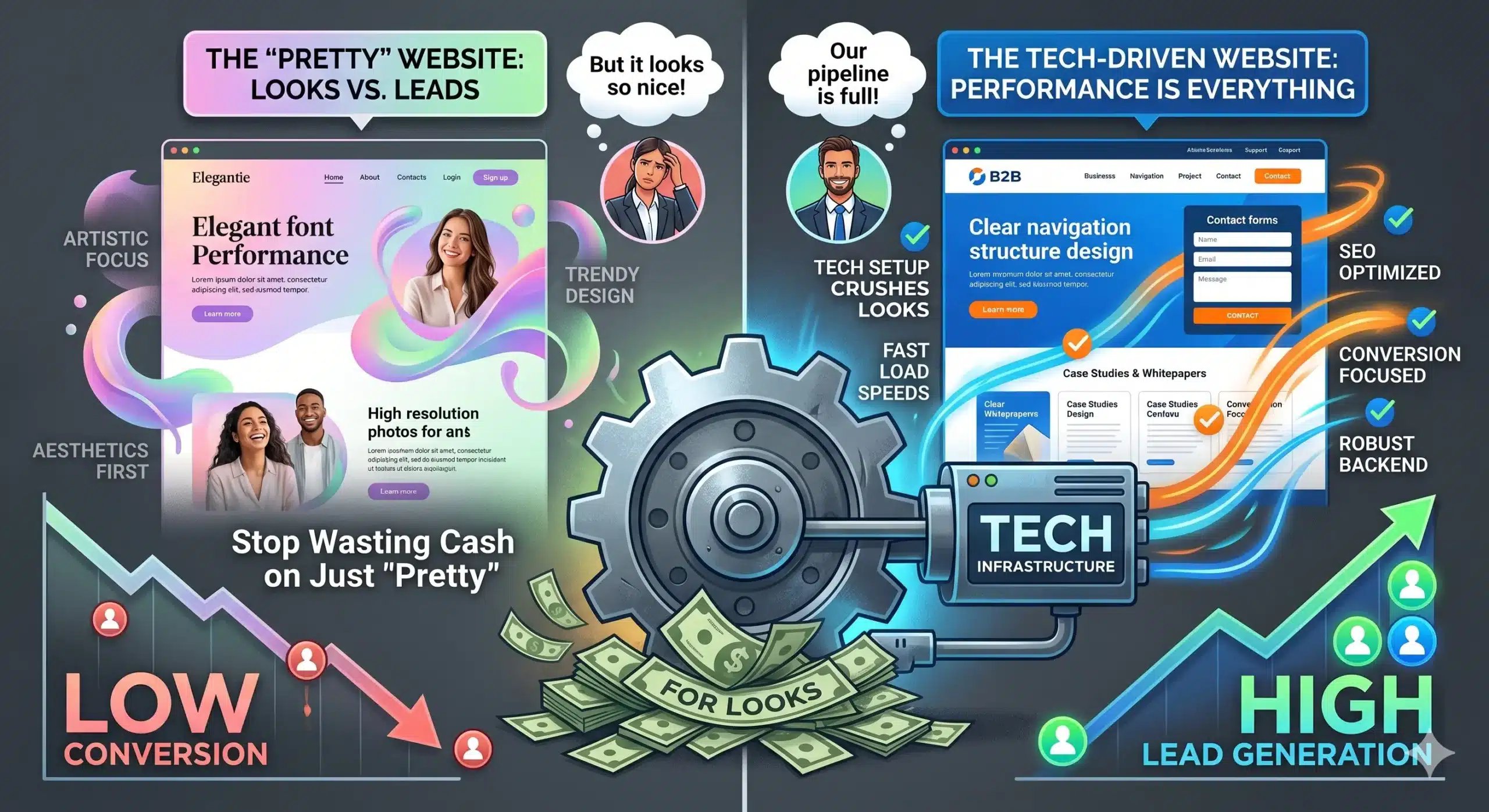
The businesses that treated SEO as a marketing function — outsourcing it entirely to agencies running templated playbooks — are the ones rebuilding from zero right now. The businesses that survived treated it as an engineering function, with the same rigor applied to their digital infrastructure as to their core product.
This is what a Fractional CTO brings to the table: not more content, not more ad spend, but a systematic, technical analysis of every layer of your digital architecture — including AI-powered solutions and automation that identify structural weaknesses at scale. It starts with a deep-crawl diagnostic — an instrumented audit of how Googlebot actually experiences your site, not how it looks in a browser to a human.
That diagnostic maps every point of structural weakness. Redirect chains that should be consolidated. Hreflang errors causing international sites to cannibalize each other. Schema markup that's present but malformed, doing more harm than good because it creates a mismatch between what you're claiming and what your page actually contains. Render-blocking resources that make Googlebot's JavaScript budget evaporate before your most important content loads. Server log analysis revealing which sections of your site Google has quietly stopped crawling — often months before you notice a traffic drop.
A site's relationship with Google is like a building's relationship with a building inspector. The inspector doesn't care how nice the lobby looks. They're checking the foundations, the wiring, the load-bearing walls.
Once the diagnostic is complete, the work is infrastructure remediation: rebuilding the architecture so it doesn't just pass Google's current standards but is resilient to the next evolution. Because there will always be a next update. The question is whether your foundation can absorb it without collapsing.
What Not to Do When You've Been Hit
The instinctive response to an organic traffic collapse is to increase ad spend to compensate for lost visibility. This is understandable as a short-term bridge, but it is not a solution — and it can actively distract from addressing the root cause. Every dollar spent on paid search while a structural penalty persists is a dollar spent renting traffic you should be owning.
Similarly, the response of "publish more content" is a trap. If Google has algorithmically reduced trust in your domain, adding more pages compounds the problem. You are building floors on a cracked foundation. More content on a technically compromised site doesn't dilute the penalty — it can accelerate it by adding more low-quality signals to the crawl budget Google is already reluctant to spend on your domain.
The correct response is diagnostic before prescriptive. You need to understand exactly which signals triggered the demotion before you can meaningfully address them. This requires technical instrumentation — not assumptions, not surface-level audits from browser-based tools, but a systematic analysis of your server logs, crawl data, Core Web Vitals field data, and structured data validation.
Recovery Is Possible — but It Takes Architecture, Not Shortcuts
The good news: Google core updates are not permanent death sentences. Sites do recover — but only after the underlying infrastructure issues are genuinely resolved, and only after Google re-crawls and re-evaluates the domain at sufficient depth. That process typically follows the next core update cycle, which means months, not weeks. This is why immediate action matters: the sooner the remediation begins, the sooner the recovery can be reflected in rankings.
Recovery follows a predictable pattern for sites that take the right approach. First, the technical debt is cleared: redirect structures consolidated, crawl traps eliminated, duplicate content resolved through canonicalization rather than workarounds. Second, Core Web Vitals are brought into the "Good" threshold across the board — not just on desktop, but on mobile at the 75th percentile of real user data. Third, entity structuring is formalized: structured data is implemented accurately, NAP consistency is audited across directories and social profiles, and E-E-A-T signals are reinforced through authorship markup and external validation.
Sites that execute all three in parallel, rather than sequentially, recover faster. This is where the Fractional CTO model delivers disproportionate value: coordinating infrastructure remediation, front-end performance engineering, and entity strategy simultaneously — across industry-specific digital ecosystems — on a timeline and budget that doesn't require building an in-house technical team from scratch.
Your Site Needs a Structural Diagnosis — Not More Plugins
At iWebHacks, we run enterprise-grade deep-crawl diagnostics to identify exactly where your site's architecture is failing Google's evolving standards. We then rebuild the infrastructure to make your business algorithm-proof — not for today's update, but for the ones coming next.
If your organic traffic has dropped, every week without remediation is another week compounding the damage. Don't take our word for it — see what our clients say. The technical foundation your competitors are building right now is the moat they will hold for years.